
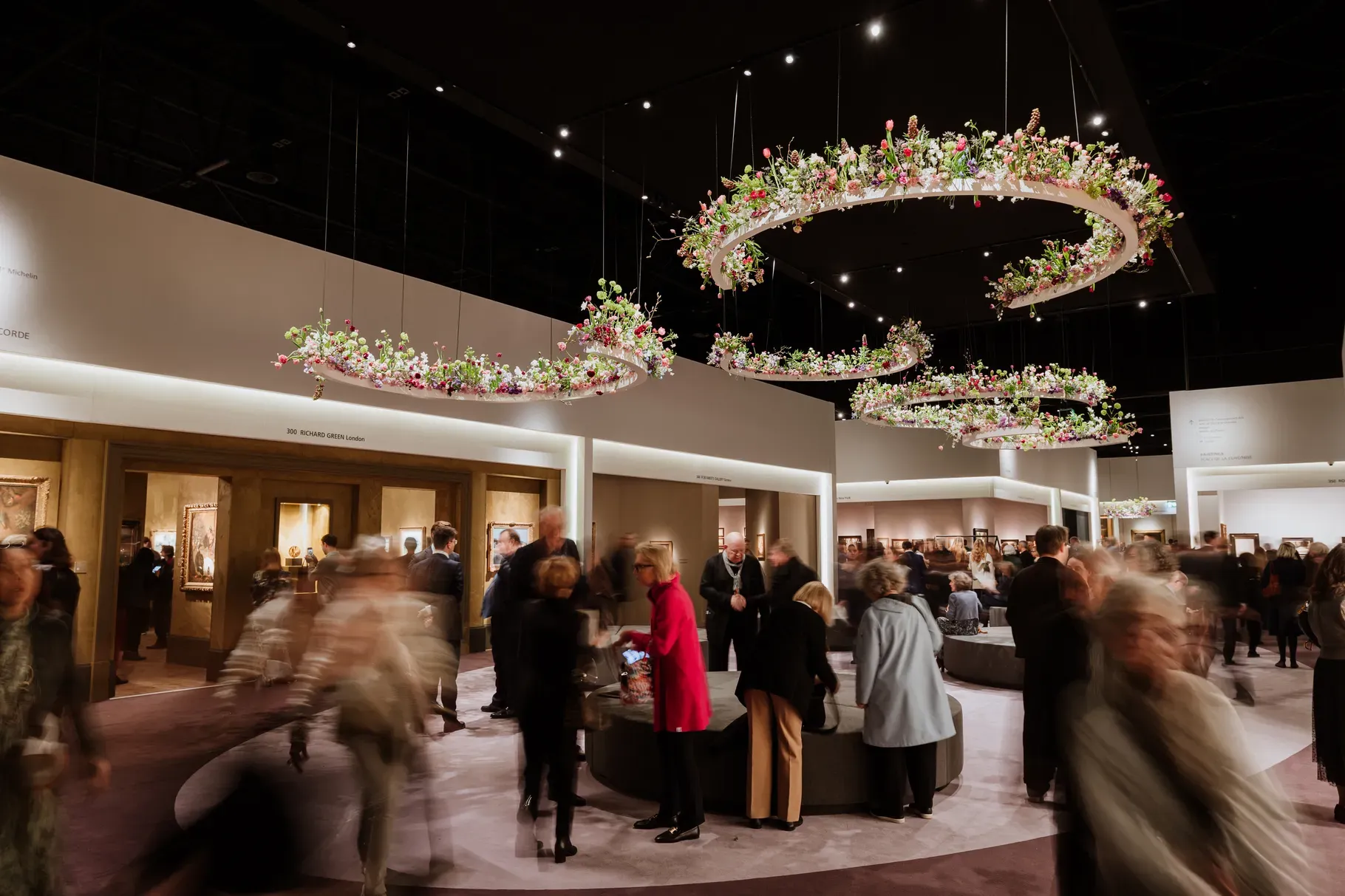
@Courtesy of TEFAF
TEFAF Maastricht has always been defined by its breadth: 7,000 years of art history, nearly 300 dealers, a vetting process unmatched in the industry. What the 39th edition revealed is that breadth is no longer just a logistical achievement — it has become a curatorial philosophy. The fair's most significant contemporary presentations this year were built not on isolation but on dialogue: with history, with other mediums, with the weight of context that only TEFAF can provide.
That context was not without friction. New EU cultural property import regulations, in full force since June 2025, created considerable logistical strain — particularly for non-European works — concentrating the fair's character in a more European register than in previous years. Geopolitical disruption further thinned collector attendance from the Middle East and parts of Asia. The result was a more selective and deliberate.
The key trends of the year
The Old/New Crossover as Standard Practice
Across the contemporary section, the most persuasive booths were structured around historical dialogue. Emerging painters shown alongside pre-Surrealists; Modernist canvases in conversation with living sculptors; photography placed against Enlightenment cartography. What was once a novel curatorial gesture at TEFAF has become the expected grammar — and the galleries that have mastered it are showing the most confidence.
Photography Elevated to Primary Medium
The most structurally significant change at this edition was photography's transition from supporting role to independent category — a shift Will Korner, TEFAF's Head of Fairs, explicitly signaled in advance. In the Focus section, Berlin's Galerie Thomas Schulte presented a dedicated solo presentation of Robert Mapplethorpe's flower portraits, whose resonance with Dutch cultural identity and the Old Master still-life tradition gave the work an unexpectedly native logic within these walls. Separately, Michael Hoppen Gallery and Daniel Crouch Rare Books staged Cities, like dreams — pairing Sohei Nishino's monumental photographic diorama maps with 18th-century town plans from Crouch's collection, including the world premiere of Diorama Map Venice, assembled from over 450 rolls of film. These were not supplementary displays. They were programmatic arguments about where photography belongs in the canon.
The Rise of Female Artists
The visibility of women artists this year was not concentrated in a single booth or curatorial gesture — it was distributed across the section as a whole. From Tracey Emin and Howardena Pindell at White Cube, to Eileen Agar, Sheila Hicks, Pacita Abad, Ana Mendieta, and Dorothea Tanning at Alison Jacques, to Helen Frankenthaler prints at Lyndsey Ingram. The pattern reflects a sustained shift in how galleries are constructing their fair programs — not as correction, but as priority.
Booth Highlights&sales

Thalita Hamaoui, Estrela, materia, memoria, 2026 @COURTESY MARIANNE BOESKY
Marianne Boesky — Thalita Hamaoui and Odilon Redon
Marianne Boesky placed Thalita Hamaoui's lush, surreally layered landscape paintings alongside works by pre-Surrealist Odilon Redon — two artists separated by more than a century, united by chromatic intensity and a shared fascination with nature as psychological territory. The arrangement was quietly persuasive, and the market responded in kind: eleven of twelve works sold on opening day, at prices between $16,000 and $60,000. That an emerging contemporary painter generated this velocity in a context historically anchored in Old Masters is not incidental. It speaks to the sophistication of the framing as much as the quality of the work.
Kamel Mennour — Vallotton, Giacometti, Rondinone
Mennour constructed his booth around the idea of formal and emotional continuity across time. Félix Vallotton's Liseuse (1912) — a woman reading, her curves deliberately echoed by the adjacent Camille Henrot bronze — anchored a presentation that moved through Giacometti and Ugo Rondinone with consistent internal logic. By day two: the Vallotton to an institution at €350,000; the Giacometti to a private collector at €700,000; the Rondinone at €350,000. Combined, approximately €1.4 million. The commercial result was strong; the curatorial argument was stronger.
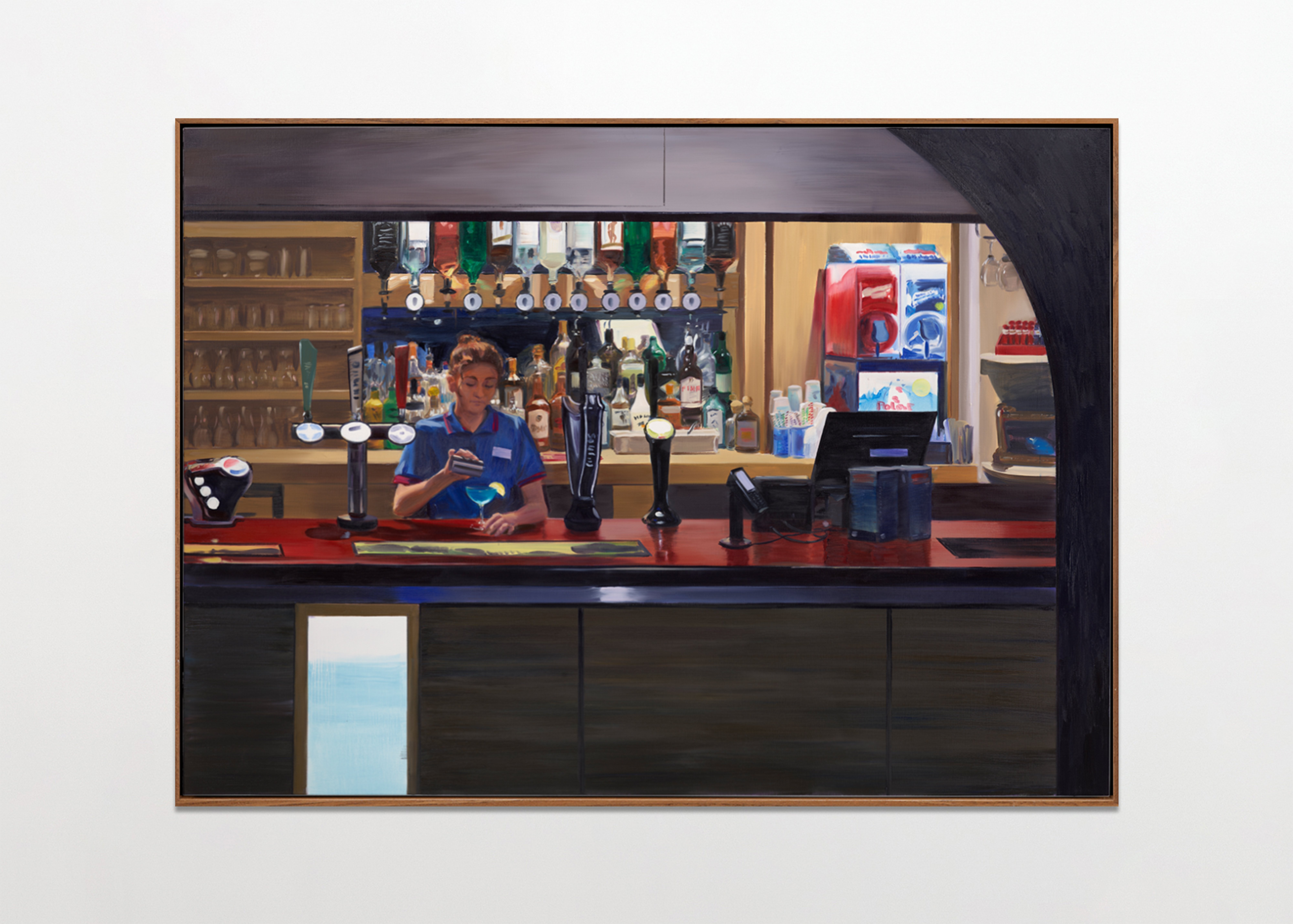
Caroline Walker, Showbar, 2026 @Courtesy of GRIMM
GRIMM — Caroline Walker, Showbar (2026)
GRIMM centred its booth on a large-scale painting made specifically for this edition by Scottish artist Caroline Walker. Showbar (2026), priced at £175,000, extends her Holiday Park series — developed through periods spent at family resorts in 2023 and 2024, photographing women at work. Walker's core concerns — labor, visibility, the spaces women occupy and are defined by — do not diminish within TEFAF's historically weighted context. If anything, the context sharpens them. The booth also included works by Angela Heisch and Tjebbe Beekman, sustaining a coherent curatorial proposition across three distinct practices.
Galleria Continua — The Broadest Spectrum on the Floor
Among the contemporary presentations this year, Galleria Continua assembled the widest range of established voices in a single space: Ai Weiwei, Anish Kapoor, Hiroshi Sugimoto, Michelangelo Pistoletto, and Berlinde De Bruyckere, whose wax and mirror works extended her 2024 Venice Biennale presentation. The booth embodied the gallery's long-held conviction that institutional-scale names can coexist coherently — and that within a fair defined by historical depth, contemporary art is most powerful when positioned inside history, not against it.
Closing
TEFAF 2026 made one thing clear: historical context does not dilute contemporary work — it amplifies it. The booths that resonated most were not those presenting the present in isolation, but those that made the conversation between past and present feel unresolved, and therefore alive. For collectors and advisors who operate at this intersection, the fair remains without equal.
동시대 미술과 역사적 맥락이 교차하는곳, TEFAF 마스트리흐트 2026 하이라이트
TEFAF 마스트리히트는 언제나 ‘범위’로 정의되어 왔다. 7,000년에 걸친 미술사, 거의 300개의 갤러리, 그리고 업계에서 비교할 수 없는 심사 과정까지. 39회째를 맞이한 이번 에디션이 보여준 것은, 단순한 규모의 달성이 아니라 ‘큐레이션 철학’으로서의 폭이었다. 올해 페어에서 가장 주목할 만한 현대 미술 전시는 고립된 작품이 아닌 ‘대화’를 중심으로 구성되었다. 역사와, 다른 매체와, 오직 TEFAF만이 제공할 수 있는 맥락의 무게와의 대화였다.
물론 이러한 맥락이 늘 순조로운 것은 아니었다. 2025년 6월 발효된 EU 문화재 수입 규정은 상당한 물류적 부담을 초래했으며, 특히 비유럽권 작품의 참가에 영향을 미쳤다. 덕분에 이번 페어는 이전보다 더 유럽 중심적 성격을 띠게 되었다. 지정학적 혼란은 중동과 일부 아시아 지역 컬렉터들의 방문을 줄였고, 결과적으로 페어는 더 선택적이고 전략적인 성격을 띠게 되었다.
올해의 주요 트렌드
역사와 현대의 교차, 이제 표준이 되다
현대 섹션에서 가장 설득력 있는 부스들은 역사적 대화를 중심으로 구성되었다. 신진 화가의 작품이 초현실주의 이전 화가와 나란히 전시되거나, 모더니즘 캔버스가 살아 있는 조각가와 대화하고, 사진 작품이 계몽주의 지도와 맞닿는 등 과거와 현재의 연결을 보여주었다. TEFAF에서 한때 신선한 큐레이션적 시도로 여겨졌던 이러한 접근은 이제 표준적 ‘문법’이 되었으며, 이를 완벽히 구현한 갤러리들이 가장 자신감 있는 모습을 보여주었다.
사진, 주요 매체로 도약
이번 에디션에서 가장 구조적으로 중요한 변화는 사진이 기존의 보조적 역할에서 독립 카테고리로 자리 잡은 것이다. TEFAF의 페어 책임자 윌 코너(Will Korner)가 사전에 명확히 신호를 준 바 있다. 포커스 섹션에서 베를린의 갤러리 토마스 슐테(Galerie Thomas Schulte)는 로버트 메이플소프(Robert Mapplethorpe)의 꽃 초상 작품을 단독으로 전시하며, 네덜란드 문화 정체성과 올드 마스터 정물 전통과의 공명을 보여주었다. 마이클 호펜 갤러리(Michael Hoppen Gallery)와 다니엘 크라우치 희귀도서(Daniel Crouch Rare Books)는 “Cities, like dreams” 전시에서 니시노 소헤이(Sohei Nishino)의 거대한 사진 디오라마 지도와 18세기 도시 계획 도면을 나란히 배치하며, “Diorama Map Venice”를 세계 최초로 공개했다. 이들은 단순한 보조 전시가 아니라, 사진이 미술사에서 차지하는 위치에 대한 구조적 논증이었다.
여성 작가의 부상
올해 여성 작가의 가시성은 특정 부스나 큐레이션적 제스처에 국한되지 않았다. 화이트 큐브의 트레이시 에민(Tracey Emin)과 하워데나 핀델(Howardena Pindell), 앨리슨 자크(Alison Jacques)의 일린 아가(Eileen Agar), 실라 힉스(Sheila Hicks), 파시타 아바드(Pacita Abad), 아나 멘디에타(Ana Mendieta), 도로시아 탱(Dorothea Tanning), 린드지 잉그램(Lyndsey Ingram)의 헬렌 프랭켄탈러(Helen Frankenthaler) 프린트까지, 전체 섹션에 걸쳐 나타났다. 이는 갤러리들이 페어 프로그램을 구성하는 방식이 단순한 ‘수정’을 넘어선 ‘우선순위’의 변화를 반영한다.
부스 하이라이트 & 판매 실적
Marianne Boesky — Thalita Hamaoui와 Odilon Redon
마리안 보이스키는 탈리타 하마우이의 풍부하고 초현실적으로 겹쳐진 풍경화와 초현실주의 이전 화가 오딜롱 르동의 작품을 나란히 전시했다. 두 작가 사이에는 세기의 간격이 있지만, 색채의 강렬함과 자연을 심리적 영역으로 탐구하는 관심으로 연결된다. 결과는 조용하지만 설득력 있었고, 시장 역시 반응했다. 개막일에 12점 중 11점이 $16,000~$60,000에 판매됐다. 신진 현대 화가가 올드 마스터 중심의 맥락에서 이러한 속도를 보여준 것은 단순한 우연이 아니다. 작품의 질만큼이나 배치와 프레임의 정교함을 보여준다.
Kamel Mennour — Vallotton, Giacometti, Rondinone
메누르는 부스를 시간에 걸친 형식적·감정적 연속성을 중심으로 구성했다. 펠릭스 발로통(Félix Vallotton)의 <읽는 여인>(1912)과 인접한 카미유 에네로(Camille Henrot)의 청동 작품이 곡선을 반복하며, 지아코메티와 우고 론디노네를 잇는 논리를 제공했다. 이틀째에는 발로통 작품이 기관으로 €350,000, 지아코메티 작품이 개인 컬렉터로 €700,000, 론디노네 작품이 €350,000에 판매되며 총 약 €1.4백만의 성과를 냈다. 상업적 성과도 훌륭했지만, 큐레이션적 논증은 더 강력했다.
GRIMM — Caroline Walker, Showbar, 2026
그림 부스는 스코틀랜드 작가 캐롤라인 워커의 이번 에디션 전용 대형 작품 <Showbar (2026)>를 중심으로 구성됐다. £175,000에 책정된 이 작품은 2023~24년 가족 리조트에서 여성 노동을 촬영하며 발전시킨 Holiday Park 시리즈를 확장한다. 노동, 가시성, 여성의 공간과 정의 등 워커의 핵심 주제는 TEFAF의 역사적 맥락 속에서도 약화되지 않는다. 오히려 맥락이 이를 더욱 선명하게 한다. 부스에는 앤젤라 하이쉬(Angela Heisch)와 티에베 베크만(Tjebbe Beekman)의 작품도 함께 전시되며 세 가지 개별 작업 사이의 일관된 큐레이션적 제안을 보여주었다.
Galleria Continua — 가장 폭넓은 스펙트럼의 작가군 프레젠테이션
현대 미술 부문에서 갤러리아 콘티누아는 한 공간에서 가장 다양한 작가를 선보였다. 아이 웨이웨이(Ai Weiwei), 아니시 카푸어(Anish Kapoor), 히로시 스기모토(Hiroshi Sugimoto), 미켈란젤로 피스토렛토(Michelangelo Pistoletto), 베를린데 드 브뤼커레(Berlinde De Bruyckere) 등이 포함되며, 특히 드 브뤼커레의 왁스·거울 작품은 2024년 베니스 비엔날레 전시를 확장한다. 이 부스는 기관급 작가와의 공존이 가능하다는 오랜 갤러리 신념을 보여주며, 역사적 깊이로 정의되는 페어에서 현대 미술은 역사 안에 위치할 때 가장 강력함을 증명했다.
결론
TEFAF 2026이 보여준 한 가지 명확한 사실: 역사적 맥락은 현대 미술을 희석시키지 않는다. 오히려 그것을 증폭한다. 가장 강한 울림을 준 부스는 현재만을 고립시켜 보여준 곳이 아니라, 과거와 현재의 대화를 ‘미완성’으로 남겨두어 살아 있는 긴장을 만든 곳이었다.
Sources:
- ARTnews: https://www.artnews.com/artnews/news/dealers-tefaf-maastricht-report-robust-sales-2026-1234777409/
- Apollo Magazine: https://apollo-magazine.com/tefaf-maastricht-2026-highlights-preview/
- Galerie Magazine: https://galeriemagazine.com/highlights-tefaf-maastricht-2026/
- The Art Newspaper: https://www.theartnewspaper.com/2026/03/11/thoroughly-modern-tefaf-why-the-maastricht-fair-is-embracing-the-20th-century
- ArtMajeur Magazine: https://www.artmajeur.com/en/magazine/2-art-news/tefaf-maastricht-2026-from-rembrandt-to-berlinde-de-bruyckere/340726
- Michael Hoppen Gallery — Cities, like dreams: https://www.michaelhoppengallery.com/exhibitions/252-tefaf-maastricht-cities-like-dreams
- TEFAF 공식 출품작 발표: https://www.tefaf.com/about/press/tefaf-announces-esteemed-exhibitor-lineup-for-tefaf-maastricht-2026
- Artsy: https://www.artsy.net/article/artsy-editorial-6-outstanding-artworks-tefaf-maastricht-2026